Thad Beaumont becomes a murder suspect after a fingerprint match
The Dark HalfThad Beaumont becomes a murder suspect after a fingerprint match when Sheriff Alan Pangborn visits the Beaumont home and identifies him as a person of interest in Homer Gamache’s killing. The encounter turns the police investigation into a crisis of identity: Thad has a party alibi, but investigators say the prints left by the murderer are exactly his, and the available evidence strains ordinary explanations.
The police arrive at the Beaumont home
Thad is upstairs in his study, writing, when the police come to the house. Liz is in the living room with their twins, William and Wendy. Since Thad’s public appearance in People magazine, unfamiliar visitors have been calling at the house, so Liz has made a habit of checking who is outside before opening the door. This time she finds Pangborn and two state troopers.
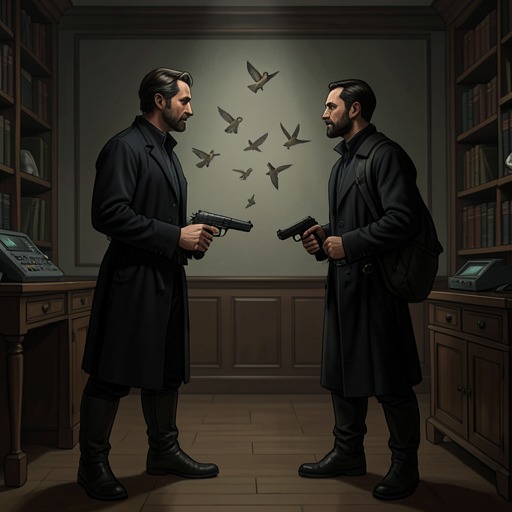
Pangborn addresses Thad by his full name, without the courtesy title, and Thad notices the change in the room’s emotional temperature: curiosity gives way to puzzlement and then worry. Thad recognizes Pangborn as the sheriff of Castle County and offers his hand, mentioning that the Beaumonts have a place on Castle Lake. Pangborn refuses to shake it. He takes a card from his back pocket and reads a version of the Miranda warning, explaining that he has come to question Thad about a capital crime and intends to take him to the Orono State Police Barracks.
Thad objects that he has no idea what is happening and refuses to go without an explanation, saying the police will need an arrest warrant if they intend to take him. His anger grows as Pangborn continues to regard him with suspicion. Liz is frightened, and one of the twins begins to cry. The stated reason for the questioning is the murder of Homer Gamache; Thad’s immediate response is to ask who Gamache is.
The alibi and the case against Thad
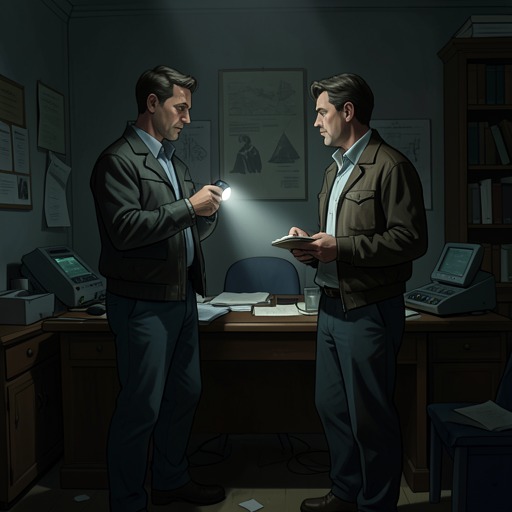
Pangborn asks Thad to account for his whereabouts between 11 p.m. on May 31 and 4 a.m. on June 1. The question initially seems to offer a way out: Liz remembers that the relevant Tuesday night was the night of a party at their house. She says the Beaumonts had a houseful of people, and Thad confirms it. Liz estimates that at least 25 guests were present. The gathering appears to support an alibi, though Pangborn warns that a good alibi can itself arouse suspicion.
After speaking with the state troopers, Pangborn returns and tells Thad that Gamache was killed between 1 and 3 a.m. on June 1. The medical examiner’s findings and an eyewitness account support that time window. Gamache was killed with his own prosthetic arm. His truck was found two nights earlier in a rest-stop parking lot on I-95 in Connecticut, near the New York border.
The truck yields several fingerprints attributed to the perpetrator. One was preserved in gum that the person had taken from his mouth and pressed onto the dashboard; another, on the rearview mirror, was exceptionally clear and was left in blood. When those prints were entered into the Armed Services Records and Identification graphics computer, Thad’s service record—and, Pangborn says, Thad’s own fingerprints—came back as a match.
Pangborn insists that this is not a loose or approximate identification. He has examined the computer sheets and overlays, and says the match is exact. That conclusion collides with the party alibi and with Pangborn’s own impression of Thad: he later admits that every instinct tells him Thad is telling the truth. He says that if the identification proves to be wrong, he will personally seek out the person responsible at the records office.
Thad challenges the fingerprint explanation
Thad asks why the evidence points to him, rather than accepting the identification as a simple clerical mistake. He raises the possibility that the quality of the prints itself is suspicious and draws on research he did for his George Stark novels. He asks how many comparison points are required before fingerprints can be admitted as evidence. Pangborn answers that Maine requires six perfect comparisons.
The exchange shifts the problem from whether the police have a match to what such a match can mean. Pangborn treats the identification as unusually strong, while Thad sees a reason to question how the prints could be so complete and so precisely his. Neither the party nor the sheriff’s personal judgment resolves that contradiction. The fingerprint evidence implicates Thad in a murder he denies committing, while the circumstances suggest that a straightforward mistake may not account for what the police have found.
An identical twin as a dark hypothesis
Thad tests the case against him with a deliberately elaborate possibility: perhaps an identical twin hosted the party while Thad went to Castle Rock, killed Gamache, and left his prints on the truck. In Thad’s mock reconstruction, the supposed twin then takes the truck to the Connecticut rest stop, steals another car, drives to New York, abandons the vehicle, and travels to Washington, D.C., before killing Frederick Clawson and returning to Ludlow. He adds, with grim humor, that Liz might have been part of the deception too.
Liz is caught off guard and laughs briefly; Pangborn responds with open surprise. The moment does not establish that such a twin exists, nor does it clear Thad. Instead, Thad’s absurdly detailed scenario gives verbal form to the case’s central impossibility: the evidence appears to place him where he says he was not, and to give another person his fingerprints. Pangborn says he already knows what checking the birth records would show, though the exchange does not make the explanation public or settle the investigation.
The investigation remains unresolved
The event leaves Thad under suspicion despite his party-night alibi and Pangborn’s sense that he is telling the truth. The case is anchored in physical evidence—the prints on Gamache’s truck, including the clear blood print on the rearview mirror—but that evidence seems to identify Thad with an exactness that ordinary doubt cannot easily undo. Thad’s questions about the six-comparison rule sharpen rather than eliminate the mystery, and his twin hypothesis points toward the hidden double at the heart of the story.
The wider narrative later places this police puzzle beside further evidence that unsettles ordinary explanations. Voice-print results arrive and prove astonishing, but the immediate account does not disclose their conclusion. Pangborn also receives a report from Fuzzy Martin about a message reading “HIGH-TONED SON OF A BITCH”; he tells himself that the report proves nothing supernatural, then recalls the fingerprints, the voice prints, and the sparrows crashing into the windows of Bergenfield County Hospital. Those later details do not resolve the original charge at this point. They deepen the pressure on Pangborn’s rational skepticism and on the reader’s understanding of why Thad’s identity has become a matter of evidence.